
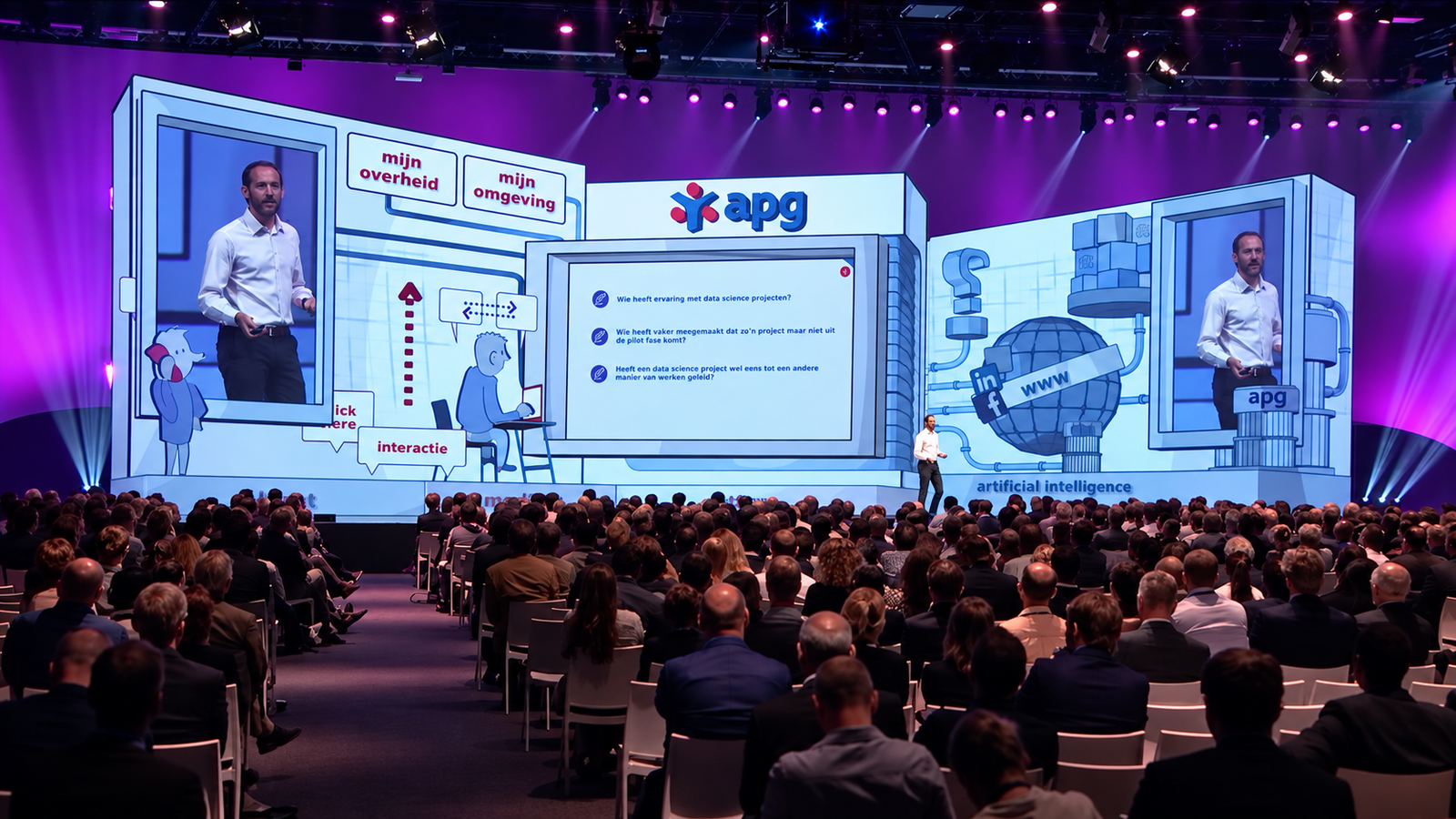
In 2017, I presented a vision for embedding intelligence throughout the digital landscape of a major financial institution. The technology we have today is very different from what we imagined. But the underlying idea has become more relevant than ever.
In June 2017, I stood on stage at SAS Forum Netherlands, an event attended by more than 1,200 people. At the time, I was Lead Data Scientist at APG, one of the largest pension administration organisations in the world.
My presentation was called Data Science as Enabler for the APG of the Future.
Artificial intelligence was already generating excitement, although the world looked very different from today. Machine learning was advancing rapidly, but developing intelligent applications still demanded substantial expertise, infrastructure and integration effort.
ChatGPT did not exist. Today’s general-purpose AI agents were still a distant prospect. The idea that people would communicate naturally with sophisticated reasoning systems, capable of interacting with business applications, was far from everyday reality.
Yet we were already exploring a vision that now feels remarkably familiar.
We called part of that vision smart sockets.
Looking back almost nine years later, what fascinates me is not that we predicted the technology. We certainly didn’t.
It is that we were asking a question that has become central to the next generation of digital transformation.
What if intelligence could become a modular, reusable capability throughout an organisation’s digital landscape, rather than something confined to individual applications?
The idea behind smart sockets
At APG, we were thinking about how data science could become much more than a collection of specialised analytical projects.
Traditionally, developing an intelligent application meant bringing together data, models, technical infrastructure and business processes for a particular purpose. The resulting intelligence was often closely connected to one specific solution.
We wanted to move beyond that.
The smart-sockets concept was built around a relatively simple idea: create places throughout the digital landscape where intelligent capabilities could be connected, used, improved and exchanged.
Imagine an electrical socket.
You do not need to redesign your house whenever you purchase a different appliance. The underlying infrastructure provides a standard connection, allowing different devices to use the same foundation.
We wanted something conceptually similar for intelligence.
Instead of embedding every algorithm deeply into an individual application, we envisioned a more flexible architecture in which analytical intelligence could be made available wherever it added value.
A customer interaction could benefit from predictive insights. An operational process could use intelligent recommendations. A decision could be supported by a specialised model. And those capabilities could evolve without constantly rebuilding the surrounding application landscape.
SAS described our broader ambition at the time as creating an agile data factory.
That was an important part of the thinking: making data science scalable, reusable and adaptable, rather than dependent on isolated initiatives.
At the time, we were largely approaching the challenge from the perspective of data, algorithms and software architecture.
What we could not foresee was how dramatically the nature of intelligence itself would change.
The future arrived through a different door
Fast-forward to 2026.
Large language models have changed our understanding of what software can do.
With technologies such as GPT, we can interact with systems through natural language, interpret unstructured information, reason across different sources and coordinate increasingly complex activities.
And with the emergence of the Model Context Protocol, or MCP, intelligent systems have gained an open standard for discovering and interacting with external tools and information sources.
MCP servers can expose capabilities to AI applications, allowing models to retrieve information, use services and initiate actions within defined permissions.
The resemblance to our earlier thinking is striking.
The intelligence is no longer necessarily embedded within a particular application. It can connect to capabilities distributed across the digital landscape.
But there is a fundamental difference.
In 2017, we imagined connecting specialised intelligence to applications. Today, increasingly general-purpose intelligence can connect itself to specialised capabilities.
That reversal is profound.
Our original thinking involved intelligent components that could be integrated into business processes. The intelligence itself was typically developed for a specific purpose.
Today’s language models can interpret a request, determine which capabilities might be useful and, through technologies such as MCP, invoke the tools needed to perform a task.
The interface is no longer necessarily a predefined screen, workflow or application.
Increasingly, the interface can be a conversation.
And the software behind that conversation can become dynamic.
To be clear, MCP is not the realisation of our original architecture, nor does it provide intelligence by itself. It is an interoperability standard, and secure, reliable enterprise deployment still requires substantial engineering.
But functionally, the parallel is remarkable.
We imagined a landscape prepared to receive intelligence.
Now we are beginning to see intelligence capable of navigating that landscape.
What we underestimated
There is something humbling about revisiting an old technological vision.
Some ideas turn out to be remarkably resilient. Others become irrelevant. And occasionally, the world finds a much more powerful way to achieve something you once considered ambitious.
We were thinking about making advanced analytical capabilities more accessible and easier to integrate.
What we underestimated was the possibility that intelligence would become sufficiently general-purpose to work with capabilities that were never designed for a particular AI model.
We also underestimated how quickly natural language could become a universal interface between people, information and software.
The implications go far beyond improving existing applications.
When an intelligent system can understand an objective, access relevant information and coordinate actions across different services, the boundaries of individual applications become less important.
Processes no longer have to be designed entirely around the limitations of software interfaces.
And increasingly, neither do organisations.
That opens possibilities we could only partially imagine in 2017.
It also raises difficult questions about reliability, control, accountability, security and the relationship between human and machine decision-making.
Making intelligence accessible is one thing. Making it trustworthy and economically valuable is quite another.
Nine years of learning changed my perspective
Perhaps the most interesting difference between then and now is not technological.
It is how my own perspective has evolved.
In 2017, I approached these challenges primarily as a data scientist. I was fascinated by the possibilities of algorithms, analytical models and the architectures required to make them useful.
Over the years that followed, my responsibilities gradually broadened.
I moved further into technology leadership, innovation, digital product development, business strategy and organisational transformation. I experienced the realities of developing new propositions, introducing technology into established organisations and translating ambitious ideas into decisions that could actually be executed.
That experience changed how I look at innovation.
I still value the technical foundations enormously. Understanding what technology can and cannot do remains essential, particularly when its development accelerates as rapidly as AI has.
But I have learned that technological possibilities are rarely the biggest obstacle.
The harder questions concern purpose, economics, organisational structures, incentives, governance and leadership.
A technically elegant solution can fail because it does not address a meaningful business problem.
A promising innovation can struggle because the surrounding organisation is not prepared to adopt it.
And an organisation can implement sophisticated technology successfully while missing the much larger strategic opportunity that technology creates.
Today, I would approach the smart-sockets vision differently.
I would start less with the question of how we integrate intelligence into the existing digital landscape, and more with what that landscape should look like when intelligence becomes widely available.
That distinction may sound subtle.
Strategically, it changes almost everything.
The next challenge is not connecting AI. It is redesigning the business around it.
We now have technologies that make many aspects of our earlier vision technically achievable.
But connecting intelligent agents to existing systems is only the beginning.
The real opportunity lies in reconsidering how organisations create value.
If intelligence can move across applications, why should every customer journey remain constrained by the boundaries of those applications?
If agents can coordinate activities across multiple services, why should every process continue to follow historically established departmental structures?
If specialised knowledge and analytical capabilities become increasingly accessible, which parts of an organisation’s existing value proposition will remain distinctive?
These are no longer primarily questions for data scientists or software architects.
They belong on the agenda of executives and boards.
This is also where I see a potential risk in today’s enthusiasm for AI.
We are remarkably good at adopting new technology within the structures we already know.
We introduce copilots, develop agents, create integrations and automate existing processes.
All worthwhile activities.
But we should not confuse modernising our technology with fundamentally reconsidering our business.
The most consequential opportunities may emerge when we challenge the assumptions on which that business was originally designed.
That requires understanding technology, certainly. But equally, it requires strategic imagination, commercial judgement and the ability to translate ideas into organisational reality.
A vision is a starting point, not a destination
When I revisit our 2017 presentation, I see an earlier version of a conviction that has stayed with me throughout my career.
Technology becomes truly valuable when it allows us to rethink what is possible.
Our smart-sockets vision was one attempt to make intelligence available throughout an organisation. It was ambitious for its time, but still limited by the technologies and assumptions we understood.
What has happened since is more extraordinary than we anticipated.
And I suspect the same will be true when we look back at today’s AI ambitions another nine years from now.
The lesson I take from this is not that we should try to predict the future with greater precision.
It is that we should develop a deeper understanding of what is fundamentally changing, remain willing to challenge our assumptions and build organisations capable of adapting as the future unfolds.
That philosophy has shaped my journey from data science to technology leadership, business transformation and strategic advisory work.
It is also central to why I founded Omniscend.
Today, my work is less about imagining individual technological solutions and more about helping leaders understand the bigger picture: what is changing, what it means for their organisation, and which choices will matter most.
The technology has evolved beyond what we could imagine in 2017.
My perspective has evolved with it.
But the underlying ambition remains remarkably consistent.
Not simply to make existing systems smarter, but to use intelligence to create a fundamentally better future.
And looking at what is now becoming possible, I suspect we are still only at the beginning.
Looking back: SAS Forum Netherlands, 2017
On 9 June 2017, I presented Data Science as Enabler for the APG of the Future at SAS Forum Netherlands in Nieuwegein.
The conference attracted more than 1,200 attendees, and SAS’s original event report described our ambition at APG as developing an agile data factory.
Watch the original SAS Talk (2017)
Read SAS’s original event report
For those interested in the technical developments discussed in this article, the Model Context Protocol provides an accessible introduction to the open standard enabling AI systems to interact with external capabilities.
Roel Moradi is the founder of Omniscend, an independent strategic advisory practice helping executives, entrepreneurs and boards navigate consequential decisions, technological disruption and organisational transformation.